
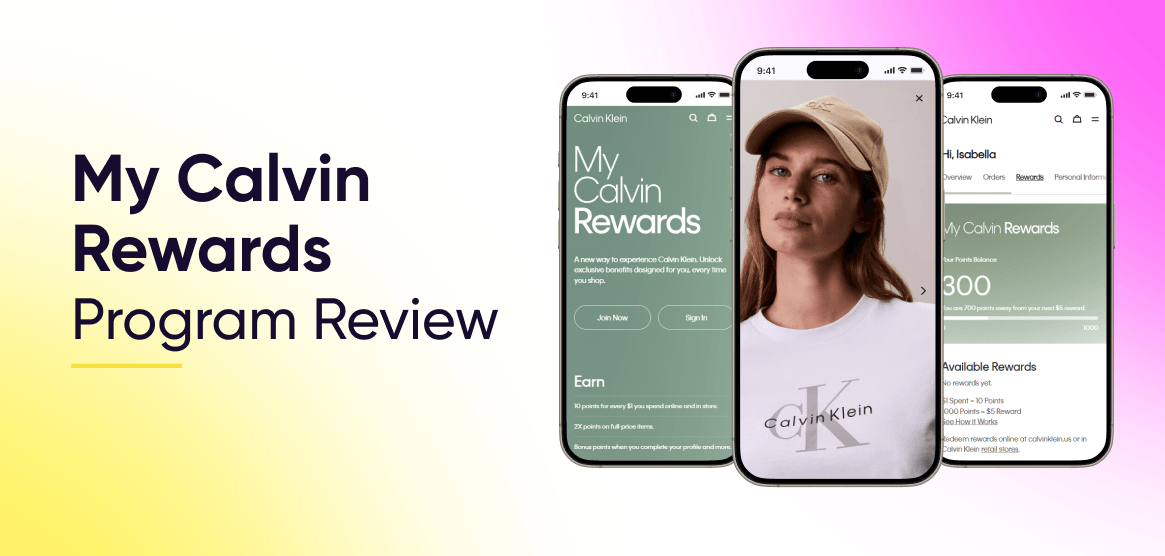
Calvin Klein doesn’t need an introduction. Since 1968, the brand has defined a particular strain of American minimalism: Aspirational, clean, quietly provocative. It sells not just clothing, but an attitude.
So when a brand with that kind of cultural equity launches a loyalty program called My Calvin Rewards, the question isn’t whether it will work. The question is whether it reflects what the brand actually stands for.
A loyalty program dressed in Calvin Klein’s aesthetic still needs to drive repeat purchases, protect full-price integrity, and turn one-time buyers into lifetime members. Let’s see how it measures up.
Also, before you dive in, make sure to check out our Global Customer Loyalty Report, which contains the latest region- and industry-specific loyalty statistics. Yes, fashion included!

Fashion’s Retention Problem: Why Acquiring Customers Is the Easy Part
Fashion brands are exceptionally good at acquisition. They invest heavily in campaigns, influencer partnerships, and product drops that drive first-time purchases.
Retention is a different story. McKinsey’s State of Fashion 2026 notes that over half of industry executives now cite retention strategies as a key priority, a sharp signal that the industry has been over-indexing on attention at the expense of loyalty.
The gap between purchases is really where fashion brands lose customers. EY’s Future Consumer Index (2025) found that 73% of consumers changed their buying habits following price increases, proof that value perception now competes directly with brand loyalty.
In a category defined by seasonality, keeping a customer engaged between drops is the hardest, most commercially important problem to solve.
Why Fashion Brands Are Betting on Loyalty Programs
The business case is clear. According to Antavo’s Global Customer Loyalty Report 2026, 89% of fashion companies agree that loyalty programs deliver extra value they wouldn’t get otherwise, and 81% report active satisfaction with their programs.
Fashion retailers now dedicate 49% of their total marketing budget to CRM and loyalty, a figure that reflects how central member relationships have become to commercial strategy.
Beyond revenue, loyalty programs serve as first-party data engines: 71% of fashion brands running a program plan to adjust their loyalty strategy in the coming years, with personalization and incremental revenue as the dominant northstar metrics.

The Earn Mechanic: Simple by Design
The My Calvin Rewards program operates on a straightforward earn structure: members earn 10 points per $1 spent online at calvinklein.us (plus Canada, etc.) and in any participating Calvin Klein store.

Every 1,000 points converts to a $5 reward discount, effectively a 5% return on spend. There are no tiers, no status levels, and no minimum spend to join. The simplicity is deliberate.

Calvin Klein’s customer base spans demographics and purchase frequencies; a flat, accessible earn structure removes friction and keeps the entry barrier low.
For a brand selling everything from $30 underwear to $400 outerwear, a tiered model would risk alienating the casual buyer entirely.

Pro tip: Before defaulting to tiers, audit your actual customer purchase frequency. If the majority of your members transact fewer than three times per year, a tier structure creates aspiration with no realistic path to reach it.
A flat, transparent earn rate keeps low-frequency buyers engaged and eligible to be converted.
The 2X Points Multiplier: A Full-Price Behavior Driver
Here is where My Calvin Rewards gets strategically interesting. Members earn double points on full-price items, meaning products purchased at list price with no markdown applied.
Why This Mechanic Matters for Margin
Fashion brands bleed margin through perpetual promotions. The 2X multiplier reframes the conversation: full-price purchases aren’t just good for the brand; they’re better for the member too.
It’s an elegant incentive alignment. Rather than training customers to wait for sales, the program rewards those who don’t.

For loyalty marketers tracking incremental revenue and average order value, this is exactly the kind of behavior-shaping mechanic that separates a transactional program from a strategic one.
Pro tip: If your program includes an accelerator on full-price purchases, make it visible at the point of decision, on product pages, in the cart, and at checkout.
Members who see the bonus points calculation in real time are more likely to convert at full price rather than waiting for a promotion. Surfacing the earn differential is half the battle.
The My Calvin Rewards Benefits Stack: Access Over Discounts
Beyond points, the My Calvin Rewards program delivers a curated set of non-transactional benefits:
- An exclusive birthday gift,
- Early access to new styles and collections,
- Personalized offers and experiences,
- Free standard shipping on orders over $50,
- Free returns.

The framing matters here. Calvin Klein leads with access and experience, not discounts. Early access to new collections is a benefit that costs the brand very little operationally, but delivers high perceived value to a customer who cares about being first.
For a brand where aesthetic identity is a core part of the purchase motivation, that positioning is exactly right.
Pro tip: Audit your benefit stack and ask which items feel like brand benefits and which feel like operational concessions. Free returns and free shipping are table stakes in 2026; they retain members, but they don’t excite them.
Lead with the benefits that reinforce your brand identity. Access, exclusivity, and personalization should be the headline.
Profile Completion & Bonus Points: The First-Party Data Play
My Calvin Rewards program members earn bonus points for nontransactional activities, such as completing their member profile.

Why is this significant? Profile completion unlocks the data that makes personalization possible: birthday, preferences, purchase history, contact details.
A loyalty program that can’t personalize is leaving its most powerful lever untouched.
Pro tip: Build a progressive data enrichment strategy: reward members for completing different profile attributes across multiple touchpoints over time.
The goal isn’t a filled-in form; it’s a continuously updated first-party data asset that powers your personalization engine.
Omnichannel Earn and Redeem: Closing the Loop
The My Calvin Rewards loyalty program supports both earning and redemption across online and in-store channels in the US, Canada, and Puerto Rico (with certain limitations).
In-store, members identify themselves via phone number, email address, or member ID. Online, members sign in to their loyalty account to apply available rewards at checkout.
Pro tip: If you run an omnichannel program without a digital wallet pass or app-based member card, track your in-store loyalty ID capture rate as a standalone KPI.
A low capture rate means your omnichannel program is effectively a digital-only program, and your in-store sales data is invisible to your loyalty engine.
Frequently Asked Questions About the My Calvin Rewards Loyalty Program
How does the My Calvin Rewards program help Calvin Klein compete on value without resorting to fast fashion-style discounting?
This is the central tension for any premium fashion brand right now: Value-conscious consumers are circling, but a race to the bottom on price destroys the brand equity that justified the price point in the first place. My Calvin Rewards solves this elegantly. The earn mechanic rewards loyalty, not bargain hunting.
Why did Calvin Klein choose a single-tier structure rather than a tiered model?
Calvin Klein’s customer base spans a wide range of purchase frequencies and average order values, from underwear replenishment buyers to full-collection shoppers. The single-tier approach keeps every member in the same program, removes the psychological friction of “not reaching the next level,” and ensures the brand’s occasional buyers remain engaged and earning. For a brand with Calvin Klein’s breadth of product and customer type, inclusivity is a smart long-term play.
How does the 2X full-price multiplier help Calvin Klein protect its pricing strategy?
Fashion brands that train customers to wait for promotions erode both margin and brand equity over time. The 2X multiplier on full-price items creates a concrete financial incentive to buy at full price: Members effectively receive a higher return on their spend when they don’t wait for a sale. It’s a pricing strategy embedded inside a loyalty mechanic, which is precisely where it should live.
How does the My Calvin Rewards program keep members engaged during the dead zones between fashion seasons?
Fashion’s calendar creates natural engagement peaks: New collection drops, seasonal sales, key gifting moments. The challenge is everything in between. My Calvin Rewards addresses this through a combination of mechanics: bonus point opportunities, early access previews, and personalized offers that aren’t tied to the product calendar. Fashion loyalty marketers should audit how many of their touchpoints are calendar-driven versus member-driven
5 Things Loyalty Marketers Can Learn from The My Calvin Rewards Program
My Calvin Rewards understands something important: a luxury-adjacent brand cannot run a supermarket loyalty program and expect it to land well. The program keeps the mechanics clean and the benefits on-brand:
- Simplicity is a strategic choice. A flat earnings structure removes friction and keeps every member eligible.
- Use your multiplier to protect margin. Double points on full-price items quietly incentivize members to buy before the markdown.
- Lead with brand-first benefits. Early access and exclusivity reinforce what Calvin Klein stands for.
- Profile completion is your data foundation. Bonus points for filling in a profile are only as valuable as what you build on top of them. Design for progressive enrichment, not a one-time form.
- Track in-store ID capture rate. If members aren’t being identified at the point of sale, your in-store data is invisible to your loyalty engine.
The real takeaway for loyalty marketers: You don’t need complexity to build a coherent program. You need alignment between your mechanics and your brand’s commercial priorities. Those two things, done well, are enough.

Ready to build or refresh your own loyalty program? With Antavo’s Loyalty Ecosystem and significant expertise in the fashion and retail loyalty sphere, we can help you create a loyalty program meant for engagement and long-term retention instead of sporadic sales spikes!
Antavo’s AI-powered loyalty platform is built on the principle of turning loyalty into an operating system for customer engagement.
- The Planner helps teams translate engagement ideas into loyalty program structures.
- The Engine runs loyalty mechanics in real time.
- The Optimizer uses AI to interpret performance data and reveal what actually drives behavior.
Together, they allow loyalty teams to run programs that evolve continuously instead of repeating the same campaigns.
And that’s when loyalty stops generating activity and starts generating growth. If you are interested in what Antavo has to offer, be sure to book a call!

Zsuzsanna Ban Zsuzsanna Ban LinkedIn profile
Zsuzsanna is a Loyalty Specialist and Certified Loyalty Expert™ with years of experience in digital marketing and e-commerce. Zsuzsanna is known for having an analytic approach and high-level communication skills, helping her deliver engaging content. In her free time, she enjoys watching Formula 1 and listening to endless Taylor Swift playlists.


