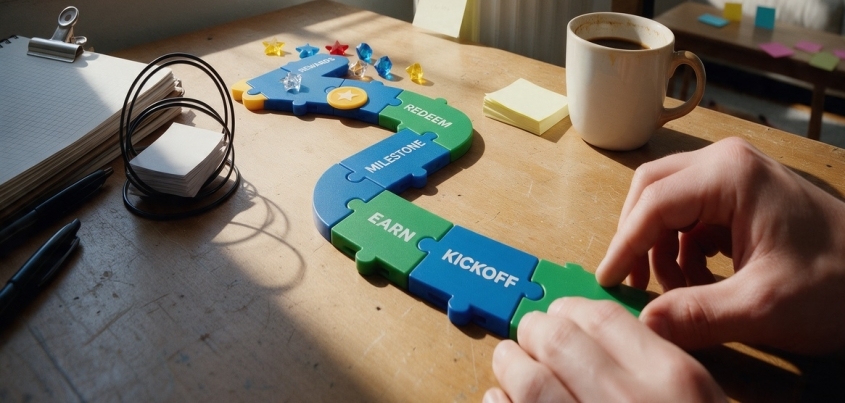

Customer engagement in loyalty programs is where habit building starts. The first four pillars in this series, recognition, exclusivity, community, and personalization, cover how a brand sees a customer, how far ahead it lets them look, who belongs, and what’s relevant to them. Engagement takes personalization’s answer and turns it into a loop the customer keeps returning to on their own.
If you’d like to get a helping hand in building the concept for your loyalty program, make sure to download our worksheet:

The Six Pillars of Customer Connection
A durable customer relationship isn’t built from a single lever. It splits into six distinct dimensions: three relational and three mechanical. The relational three, recognition, exclusivity, and community, are usually where the brand buyer’s attention lands first, felt as identity and belonging. The mechanical three, personalization, engagement, and utility, are where the operations buyer tends to start, felt as mechanics and value exchange. They’re the same six dimensions either way, just a different door in.
Key takeaways
- Recognition, “you see me.” The customer is known wherever they show up, greeted by name and tier, with status carrying across channels and milestones acknowledged.
- Exclusivity, “you give me first access.” The customer gets access others don’t, through early drops, members-only products, and priority.
- Community, “you belong with us.” The customer belongs, both with the brand and with other customers, through clubs, events, and shared challenges.
- Personalization, “you know me.” Relevance is built from the customer’s own data, in the form of tailored offers, content, and journeys.
- Engagement, “you make this fun.” Play and interaction build habit, through gamification, streaks, missions, and surprise moments.
- Utility, “you reward me meaningfully.” The customer gets tangible value they actually want, in the form of points worth redeeming, useful perks, and partner offers.
No brand builds all six equally, and that’s by design rather than a gap to close. The point isn’t to check every box. It’s knowing which ones a program is built on deliberately, and which ones are happening by accident.
Engagement, or “You Make This Fun”
Engagement is all about interactions that build habit: gamification, streaks, missions, quizzes, and surprise moments that bring a customer back without being told to. While personalization decides what’s relevant to this customer; engagement turns that relevance into a loop instead of a one-time offer.
This pillar sits closest to community, but the bottom line still holds: community requires other people to be real, engagement doesn’t. A customer can finish a streak alone. They can’t have a club alone. That’s why it’s easier to introduce or boost engagement as a marketing strategy, because you can focus on the individuals.
Engagement Through Behavioral Psychology
B.F. Skinner said that the key to a persistent behavior is to have the rewards arrive unpredictably, for repeated action, rather than on a fixed schedule. It’s the same schedule that makes slot machines resistant to extinction, a player keeps pulling the lever because the next pull might pay out.
This is worth stating as a feature of the science, not a scandal to bury. It’s important to establishing that engagement mechanics sit on old, heavily studied behavioral territory. The psychology is identical, but what draws the line between fun and manipulative is whether the customer can walk away without losing what they have earned. That’s the line marketers should tread carefully when it comes to engagement and habit-building.
Engagement in Customer Retention and Marketing
What Engagement Actually Moves, and Its Limit
The commercial case for engagement is behavioral, not emotional: frequency and visit cadence, not whether a customer would recommend the brand or feel it’s relevant to them. Engagement can drive frequency without building the company-loyalty kind of attachment covered three pillars back. A customer can be highly engaged with a brand’s game and still leave the moment a competitor’s game is better, because the attachment was to the mechanic, not the brand. Fortnite’s Battle Pass is the clearest version: extremely high engagement, with no guarantee it transfers anywhere the brand actually needs it to.
Find out what’s the best way to uncap engagement-based opportunities for your business through real-life insights.
The Pitfall: When the Reward Becomes the Reason
When an engagement mechanic works too well, the game quietly replaces the reason a customer showed up in the first place. If the challenges end or the game goes stale, there’s often nothing left underneath to bring them back. The fix is treating the mechanic as something to keep iterating rather than set once and left alone: new missions, refreshed rewards, an evolving structure instead of the same streaks running unchanged for a year.
Engagement in Loyalty Programs
In practice, engagement can run on a wide variety of mechanics, like gamification triggers, streaks, missions, quizzes, and surprise moments like a prize wheel. For example, the Antavo-powered LeMieux Insiders is a uses gamified missions and a visible tier-progression path to give each member their own reason to keep moving, independent of anyone else in the program.
Another Antavo success story, Yeokens by Yeo Valley Organic, uses not one, but three different gamification features. As a result, active loyalty members buy 2x more than regular customers.
Frequently Asked Questions for Customer Engagement in Loyalty Programs
Is engagement just another word for gamification
Not quite. Gamification is the toolkit, points, badges, streaks, missions. Engagement is the outcome those tools are meant to produce: a customer who returns on their own, without a discount forcing the visit.
Do engagement mechanics work for low-frequency purchase categories?
They can, if built around a related habit rather than the purchase itself. A furniture brand can’t run a weekly streak on furniture buying, but it can run one on design inspiration between purchases.
How can a brand tell healthy engagement from reward-hunter behavior?
Closing
Engagement is what makes relevance actionable: it takes what personalization already knows and turns it into a habit the customer keeps on their own. That habit runs on real, well-studied psychology, the same psychology behind a slot machine, and the honest version of this pillar keeps a customer able to walk away without losing something they already earned.
Antavo is the AI loyalty and incentives platform that brings together loyalty, promotions, and agentic AI to turn customers into regulars: the customers who come back on their own, buy more often, and bring others with them. For more than a decade, Antavo has powered identity-led loyalty strategies for brands including SKIMS, Paul Smith, KFC, Flying Tiger Copenhagen, and Hyatt’s Inclusive Collection. Marketers build, change, and launch programs and promotions themselves, without waiting on engineering.
If you’re tired of paying to win the same customers twice, book a call with our experts and see how Antavo turns them into regulars.


